PMJAY, NHCX & Digital Claims Management in India (2026): Complete Guide for Hospitals, Clinics and Healthcare Providers
A comprehensive compliance blueprint for healthcare facilities navigating the National Health Claims Exchange transition, ABDM integration, and digital claims workflows.
Last Updated: 22 October 2026
Need help mapping your hospital software to NHCX APIs?
Guide Contents
Related Resource
Best PMJAY & NHCX GuideExecutive Brief
India's healthcare sector is undergoing a major digital transition. The integration of the Pradhan Mantri Jan Arogya Yojana (PMJAY), the National Health Claims Exchange (NHCX), and the Ayushman Bharat Digital Mission (ABDM) marks the largest upgrade to the country's healthcare infrastructure. For hospitals, clinics, and healthcare providers, adapting to this digital ecosystem is essential to manage claims and billing efficiently.

This guide explains how PMJAY and NHCX digital claims management work in India. It provides clear, actionable steps for hospitals and clinics preparing for the mandatory digital transition. Whether you operate a multi-specialty hospital or a local clinic, this resource will help you transition to digital claims smoothly.
The National Health Authority (NHA) guidelines require healthcare facilities to adopt standardized digital records and automated claims routing. Transitioning from manual, paper-based claims to digital systems will help your hospital speed up insurance verification, patient discharge, and scheme reimbursements.
Looking for ready-to-deploy PMJAY & NHCX Hospital Software?
This guide details technical standards. If you want certified software with automated TMS 2.0 dual-entry sync and live FHIR R4 claim exchange:
Estimate Your Hospital's NHCX Integration Timeline & TCO
Adjust the parameters below to determine target timelines, first-year implementation budgets, and projected payment acceleration.
Include sandbox phase support
* These values are indicative estimations only. For a precise and tailored evaluation of your facility, please .
Understanding PMJAY: India's Flagship Health Insurance Scheme
The Pradhan Mantri Jan Arogya Yojana stands as the world's largest government-funded health insurance program. Launched in September 2018 under the Ayushman Bharat initiative, PMJAY provides health coverage of ₹5 lakh per family per year to over 500 million beneficiaries across India. This represents approximately 40% of the nation's population, primarily targeting economically vulnerable families.
Core Features of PMJAY
PMJAY operates on a cashless model at empaneled hospitals. Eligible beneficiaries receive treatment without upfront payment. The scheme covers secondary and tertiary care hospitalization across 1,393 treatment packages including medical and surgical procedures. Coverage extends to pre-existing conditions from day one, with no caps on family size or age restrictions.
Beneficiary Coverage
The program identifies eligible families through socio-economic caste census data. Both rural and urban populations qualify based on specific deprivation criteria. Rural beneficiaries include families living in one-room houses with kutcha walls, households without adult members aged 16-59, and families with disabled members.

Key Scheme Statistic
According to National Health Authority data, over 73 crore Ayushman cards have been generated as of 2025, with more than 8.6 crore hospital admissions authorized under PMJAY since inception. The program has facilitated cashless treatment worth over ₹82,000 crore across 29,000+ empaneled hospitals nationwide.
How PMJAY Claims Work: The Traditional Process
Understanding the existing claims workflow is essential before transitioning to digital systems. The traditional PMJAY claim process involves multiple stages and stakeholders. Each step presents opportunities for delays, errors, and administrative burden.
Traditional PMJAY Claims Workflow
- Patient presents Ayushman card at empaneled hospital
- Hospital verifies beneficiary eligibility through online portal
- Treatment pre-authorization requested from insurance company
- Physical documents submitted for approval
- Treatment provided after authorization
- Post-treatment claim documents compiled manually
- Physical claim files sent to insurance desk
- Multiple verification rounds with document resubmissions
- Payment processed after 30-90 days
Common Pain Points
- Manual data entry errors causing claim rejections
- Lost or incomplete physical documentation
- Long reimbursement cycles affecting hospital cash flow
- Lack of real-time claim status visibility
- Multiple back-and-forth communications for clarifications
- High administrative costs for claims processing teams
- Difficulty tracking claim lifecycle across departments
What is NHCX? The National Health Claims Exchange Explained
The National Health Claims Exchange (NHCX) is a centralized digital gateway designed by the government. It allows hospitals, insurance companies, third-party administrators (TPAs), and government schemes like PMJAY to exchange health claims information securely and in a standardized format.

Instead of your hospital maintaining separate software integrations with dozens of different private insurers and TPAs, NHCX acts as a single gateway. Your hospital management system connects directly to the NHCX portal, which standardizes how claims are submitted, reducing administrative hassle and technical costs.
The platform operates on open API standards published by the National Health Authority. These APIs define how data should be structured, transmitted, and validated across the network. Every participant—whether a large corporate hospital or a small nursing home—uses the same technical specifications.
Why NHCX Was Created: Problem-Solution Framework
India's health insurance ecosystem had become fragmented. Hospitals dealt with multiple insurers, each with proprietary systems and formats. A single facility might need to maintain 15-20 different claim submission processes. This fragmentation created several systemic problems.
- • Lack of standardization across insurance companies and TPAs
- • No real-time communication between healthcare providers and insurers
- • High claim rejection rates due to format inconsistencies
- • Lengthy settlement times impacting provider cash flow
- • Difficulty in claim status tracking and reconciliation
- • Administrative burden of managing multiple portal logins
- • Single standard format for all claim submissions
- • Real-time claim status updates and notifications
- • Automated pre-authorization processes reducing turnaround time
- • Digital document management eliminating physical paperwork
- • Unified dashboard for tracking all claims across insurers
- • Faster settlement cycles improving provider working capital
NHCX Core Components and Functionality
NHCX operates through several interconnected modules. Each component serves specific functions within the broader claims management ecosystem.
- Claims Management Module: Handles submission, tracking, and status updates for insurance claims from initiation through settlement.
- Pre-Authorization Module: Manages treatment approval requests with real-time communication between providers and insurers.
- Beneficiary Verification: Validates patient eligibility and coverage details instantly at the point of care.
- Document Management: Stores and exchanges medical records, bills, and supporting documentation digitally.
- Payment Reconciliation: Tracks payment status and facilitates financial settlement between parties.
- Analytics Dashboard: Provides insights on claim patterns, rejection reasons, and processing efficiency.
- Audit and Compliance: Maintains detailed logs for regulatory compliance and dispute resolution.
Process Simulator: NHCX-Enabled Claims Routing Gateway
Observe how clinical and financial transactions route dynamically from hospital endpoints to insurance clearinghouses.
Ayushman Bharat Digital Mission (ABDM): The Foundation
The Ayushman Bharat Digital Mission (ABDM) is the digital health framework for India. Launched in September 2021, it connects patients, doctors, hospitals, and insurers under a secure digital network. NHCX operates as the dedicated claims-processing channel within this ABDM network.
Core Components of ABDM
ABDM is built on four core registers that make digital health records shareable and secure. Any hospital or clinic joining the NHCX ecosystem needs to integrate these components into their daily front-desk and clinical operations.
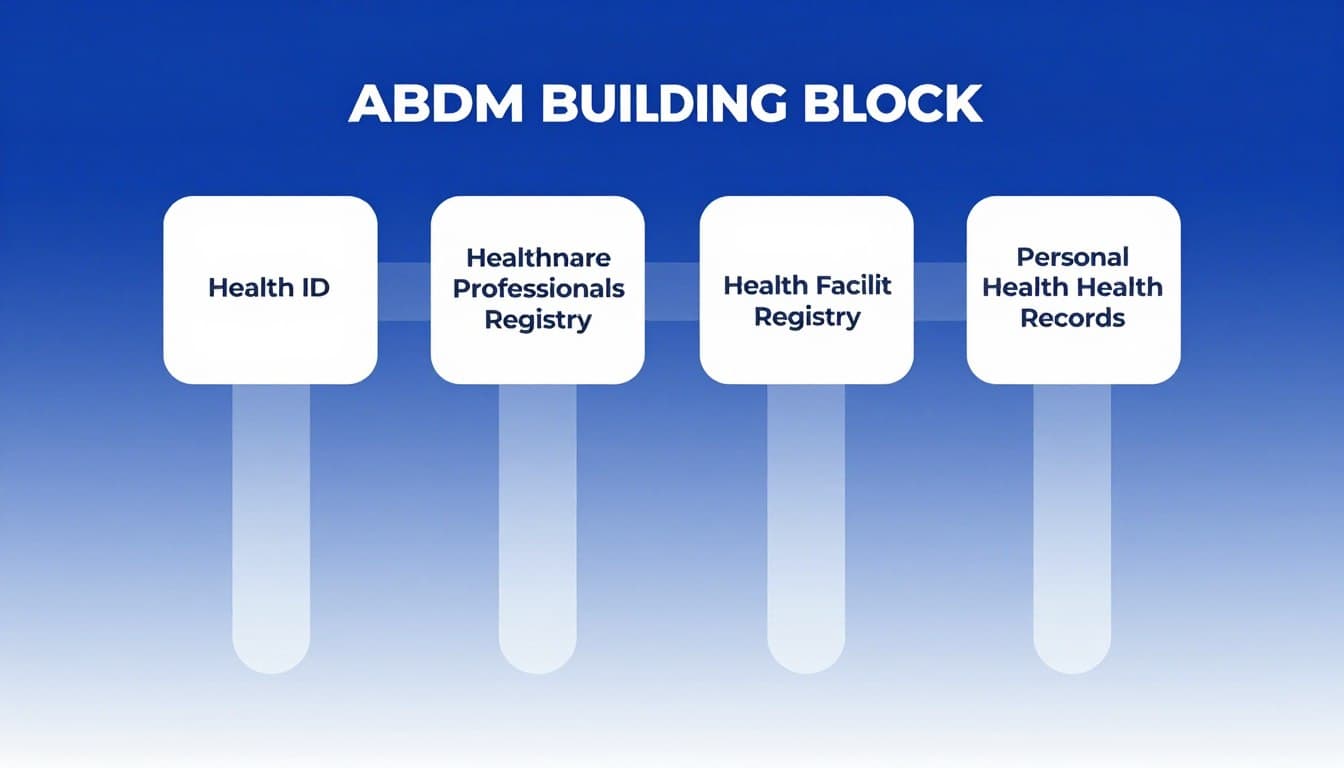
1. Health ID (ABHA)
The Ayushman Bharat Health Account creates a unique 14-digit identifier for every Indian citizen. This digital health ID links all medical records, prescriptions, diagnostic reports, and insurance claims across providers.
2. Healthcare Professionals Registry (HPR)
This registry maintains a verified database of all doctors, nurses, and healthcare workers in India. Registration includes credential verification and practice location details.
3. Health Facility Registry (HFR)
Every hospital, clinic, diagnostic center, and pharmacy receives a unique facility ID. This registry enables patient apps to discover nearby healthcare providers.
4. Personal Health Records (PHR)
The PHR system allows citizens to store, access, and share their complete medical history digitally through authorized apps compliant with ABDM standards.
ABHA: Patient Digital Health Identity
The Ayushman Bharat Health Account (ABHA) is the primary identifier for patients under NHCX. Instead of tracking multiple policy numbers or local hospital registration IDs, claims are mapped directly to the patient's unique 14-digit ABHA number.
Creating an ABHA card takes less than two minutes. Patients can generate it online, via mobile apps, or at your hospital counter using their Aadhaar details. Access to clinical records is strictly consent-based, ensuring data privacy.
Front-Desk Requirement: Hospitals participating in NHCX are required to support ABHA verification and registration at their reception desks. This ensures that both PMJAY beneficiaries and private insurance patients can link their profiles immediately.
Healthcare Data Exchange Standards
ABDM defines specific data exchange standards ensuring that information flows seamlessly between systems. These standards cover clinical documents, diagnostic reports, prescriptions, and billing information. Hospitals must adopt these formats for NHCX compatibility.
The primary standard is FHIR (Fast Healthcare Interoperability Resources). FHIR provides a framework for exchanging healthcare information electronically. ABDM has published India-specific FHIR profiles that specify exactly how data should be structured for claims, clinical summaries, and other documents.
How Hospitals Submit Claims Through NHCX: Complete Workflow
The NHCX-enabled claims process transforms traditional workflows into streamlined digital operations. The workflow involves several stages, each with specific technical and operational requirements.
Stage 1: Patient Registration and Eligibility Verification
The process begins when a patient arrives at the hospital. Unlike traditional systems where eligibility verification might take hours or days, NHCX enables real-time validation. The hospital's management system queries NHCX APIs to confirm coverage instantly.
- Patient provides ABHA number or insurance card at registration.
- Hospital system queries NHCX beneficiary verification API.
- NHCX routes request to relevant insurer or government scheme.
- System receives immediate response with coverage details.
- Hospital confirms eligibility and proceeds with admission.
Stage 2: Pre-Authorization Request Submission
Before beginning treatment, hospitals must obtain pre-authorization from insurers for planned procedures. NHCX digitizes this approval process, reducing turnaround time from days to hours or minutes.
Pre-Auth Components
- Patient details & proposed treatment plans.
- Doctor's notes & diagnostic report attachments.
- Estimated costs broken down by service category.
NHCX Pre-Auth Benefits
- Standardized formats across all insurance portals.
- Real-time automated error validations at entry.
- Eliminates faxes and physical document attachments.
Stage 3: Treatment Delivery and Documentation
With pre-authorization secured, treatment proceeds. During this phase, the hospital's clinical and billing systems document all services provided. ABDM-compliant hospital management systems capture treatment details in standardized formats automatically. When doctors enter prescriptions or when labs generate reports, all this information feeds into the patient's digital health record in FHIR-compliant format.
Stage 4: Final Claim Submission
Upon discharge or treatment completion, the hospital compiles the final claim. The NHCX claim includes detailed billing information, clinical documentation supporting the services provided, and discharge summaries.
| Claim Component | Information Required | Data Source | Validation Rules |
|---|---|---|---|
| Patient Information | ABHA number, demographics, insurance details | Registration module | Match with eligibility verification |
| Treatment Details | Diagnosis codes, procedure codes, service dates | Clinical documentation system | Align with pre-authorization approval |
| Billing Information | Itemized charges, package rates, total amount | Billing and finance module | Conform to approved package rates |
| Clinical Documents | Discharge summary, investigation reports, prescriptions | Electronic medical records | Digitally signed by treating physician |
| Supporting Evidence | Images, lab reports, consent forms | Document management system | Meet format and size requirements |
Stage 5: Claim Processing and Adjudication
Once the claim reaches the insurer through NHCX, their adjudication system processes it. NHCX provides real-time status updates throughout this process. The hospital can track whether the claim is under review, if additional documents are requested, or if payment has been approved. Insurers may raise queries seeking clarification. These queries come through NHCX as structured messages and are resolved within the same channel.
Stage 6: Payment Settlement and Reconciliation
Upon claim approval, the insurer processes payment. NHCX tracks payment status and provides notifications when funds are transferred. The hospital's finance system receives payment details including any adjustments or deductions applied by the insurer. Finance teams can match payments to specific claims automatically rather than manually reconciling bank statements.
PMJAY Software Requirements & NHCX-Ready HMS
Participating in NHCX requires specific software capabilities. Not every hospital management system (HMS) currently supports the technical standards and workflows demanded by the National Health Claims Exchange.
Essential Technical Capabilities for NHCX Integration
- ABHA Integration: Generate and validate Ayushman Bharat Health Accounts at registration, and link patient records.
- FHIR Compliance: Support Fast Healthcare Interoperability Resources standard for clinical data representation.
- NHCX API Integration: Connect to NHCX gateway through secure APIs for eligibility, pre-auth, and claims.
- Digital Signatures: Enable doctors to digitally sign clinical documents using HPR registry credentials.
Evaluation Criteria for NHCX-Ready Software
| Evaluation Criterion | What to Verify | Red Flags |
|---|---|---|
| ABDM Certification | Request proof of NHA sandbox testing completion and certification documentation. | Vendor claims ABDM readiness without certification evidence or sandbox participation. |
| Live Implementations | Ask for reference sites currently processing NHCX claims in production. | No live customers using NHCX features, only demonstrations or promises. |
| API Documentation | Review technical documentation showing NHCX API endpoint integration details. | Vague documentation, no technical specifications provided for review. |
| Data Migration | Confirm vendor provides tools and services for migrating existing patient and billing data. | No migration plan, expects hospital to manually re-enter all historical data. |
Healthcare software platforms such as Cliniqwise are building architectures aligned with India's digital health transformation initiatives. Hospitals evaluating future NHCX participation may consider software platforms that support interoperability, digital records, and ABDM-aligned workflows. The key is selecting solutions designed for India's regulatory environment.
Hospital Digital Transformation Checklist & Roadmap
Transitioning to NHCX-enabled operations requires careful planning and phased execution. A structured roadmap minimizes risks while ensuring readiness for mandatory digital claims processing.

Assessment & Planning
Duration: 4-6 WeeksThe transformation begins with a comprehensive assessment. Understanding current capabilities, identifying gaps, and securing organizational commitment are essential first steps. This phase determines the scope and budget for subsequent implementation activities.
- •Current State Analysis: Document existing software systems, workflow processes, data formats, and integration points across all departments.
- •Gap Identification: Compare current capabilities against NHCX requirements, identify specific deficiencies in software, processes, and staff skills.
- •Stakeholder Engagement: Form implementation committee with representatives from administration, clinical departments, IT, and finance.
- •Budget Development: Estimate costs for software, hardware upgrades, training, consulting support, and ongoing maintenance.
- •Timeline Creation: Develop realistic project timeline accounting for vendor selection, implementation, testing, and parallel operations.
- •Risk Assessment: Identify potential obstacles including technical challenges, staff resistance, and operational disruptions with mitigation strategies.
Challenges in Digital Claims & Practical Solutions
1. Technical Integration Challenges
Connecting legacy hospital systems with modern NHCX APIs presents significant technical hurdles. Many hospitals operate aging software that lacks API capabilities or uses proprietary data formats incompatible with FHIR standards.
- Legacy HMS lacks API integration capabilities.
- Data format mismatches with NHCX standards.
- Network timeouts during claims transmission.
- Deploy integration middleware for translations.
- Centralized master mapping tables.
- Redundant internet failover links.
2. Staff Resistance and Change Management
Technology transformation fails without staff buy-in. Doctors accustomed to paper-based workflows resist electronic documentation. Registration staff find new verification procedures time-consuming. Billing teams worry about learning curves impacting productivity.

- • Additional time required for electronic documentation
- • Fear of making errors with unfamiliar software
- • Concern about system downtime disrupting patient care
- • Resistance from senior staff comfortable with paper
- • Worry about job security due to automation
- • Frustration with multiple password requirements
- • Demonstrate long-term efficiency gains offsetting initial learning curve
- • Provide extensive hands-on training with practice environments
- • Maintain paper-based backup procedures during transition
- • Identify champions among senior staff to advocate for change
- • Emphasize how automation eliminates repetitive tasks, not jobs
- • Implement single sign-on reducing password complexity
3. Data Quality and Standardization Issues
NHCX success depends on clean, standardized data. Many hospitals discover that years of inconsistent data entry have created master data chaos. Patient names appear in multiple formats. Procedure descriptions vary. Cleansing must happen before NHCX go-live:
- Conduct data quality assessment identifying duplicates and inconsistencies.
- Clean patient master databases and standardise name formats.
- Map all internal service codes to standardized national health terminology (ICD-10 / LOINC).
4. Financial and Budgetary Constraints
Digital transformation requires significant investment. Software licensing, infrastructure upgrades, training, and consulting support create substantial costs.
| Cost Category | Small Hospital (50 beds) | Medium Hospital (150 beds) | Large Hospital (500+ beds) |
|---|---|---|---|
| Software Licensing | ₹3-5 lakhs annually | ₹8-12 lakhs annually | ₹25-40 lakhs annually |
| Infrastructure Upgrade | ₹2-4 lakhs one-time | ₹8-15 lakhs one-time | ₹30-50 lakhs one-time |
| Implementation Services | ₹2-3 lakhs one-time | ₹6-10 lakhs one-time | ₹20-35 lakhs one-time |
| Total First Year Cost | ₹8-14 lakhs | ₹25-42 lakhs | ₹85-140 lakhs |
Cost management strategies include phased implementation, negotiating bundled pricing from vendors, exploring government subsidies for ABDM adoption, and considering cloud-based solutions reducing infrastructure costs.
5. Regulatory Compliance and Data Privacy
Healthcare data carries stringent privacy protections. NHCX implementation must comply with Digital Personal Data Protection (DPDP) Act 2023 provisions, NHA data security guidelines, and patient consent requirements under ABDM.
Compliance Requirements: Hospitals must implement role-based access controls limiting staff access to patient data based on job responsibilities. All data transmissions must use encryption meeting ABDM standards. Patient consent must be obtained and documented before sharing health information.
The Future of Digital Claims in India (2026 and Beyond)
India's digital health system is evolving quickly. Keeping up with upcoming updates helps hospital leaders invest in software that stays compliant long-term. Future updates will expand beyond standard billing into wider healthcare data networks.

Key Tech Trends in Healthcare Claims
- Auto-Validation: Smart software tools will automatically check claims against insurer rules before submission, dropping rejection rates significantly.
- Rejection Forecasting: Reporting tools will help you identify common rejection patterns and recommend fixes based on previous claims.
- Digital Records Audit: Digital ledger records will offer secure, clear history of all submissions to resolve disputes with TPAs easily.
- Smart Device Integration: Vital monitors and EMR software will sync directly to health records, making documentation for claims fast and accurate.
- Voice-to-Text: Doctors can dictate clinical summaries quickly, reducing time spent on computers.
- Teleconsultation Claims: Online doctor consultations will sync with claims software, allowing patients to use insurance benefits remotely.
- Instant Approvals: Insurers are moving toward instant approval for standard procedures, authorizing payouts within minutes.
Expansion Beyond PMJAY
While NHCX initially focuses on government schemes like PMJAY, the platform is designed to accommodate all health insurance products. Private insurance companies are beginning to adopt NHCX for corporate policies and retail health products. This expansion will create truly universal health claims infrastructure.
The Insurance Regulatory and Development Authority of India (IRDAI) has issued guidelines encouraging insurers to adopt NHCX standards. As more insurers join the network, hospitals will experience the full benefit of standardized processing across all payer types.
National Health Claims Registry
Future enhancements include establishing a comprehensive health claims registry. This repository will maintain anonymized claims data across all insurers and providers. Researchers can analyze treatment patterns, cost trends, and outcome correlations. Policymakers can make evidence-based decisions on healthcare resource allocation.
Integration with Healthcare Quality Initiatives
NHCX data will increasingly feed into quality measurement and accreditation programs. The National Accreditation Board for Hospitals and Healthcare Providers (NABH) already considers digital health adoption in accreditation standards. Future frameworks may incorporate NHCX compliance as mandatory requirements.
What this means for you: Hospital leaders should view NHCX not just as a billing tool, but as the foundation for upgrading their entire hospital system. Upgrading to compliant software now prepares your clinic for upcoming features in virtual care, reporting, and patient communication.
Policy and Regulatory Developments
Regulatory frameworks continue evolving to support digital health expansion. Expected developments include mandatory NHCX participation timelines for empaneled facilities, standardized turnaround time requirements for insurers processing claims, penalties for non-compliance with data security standards, and incentive programs rewarding early digital health adopters.
Comparative Analysis: Digital vs. Traditional Claims
Understanding the concrete differences between legacy and digital approaches helps quantify transformation benefits. These comparisons provide business justification for investment in NHCX-ready infrastructure.
Processing Efficiency Comparison
| Metric | Traditional Manual Process | NHCX Digital Process | Improvement |
|---|---|---|---|
| Eligibility Verification Time | 2-24 hours | Instant (under 5 seconds) | 99% faster |
| Pre-Authorization Turnaround | 3-7 days | 4-24 hours | 80-90% faster |
| Claim Submission Time | 45-90 minutes per claim | 5-10 minutes per claim | 85-90% reduction |
| Claim Status Visibility | Phone calls, no tracking | Real-time dashboard updates | Complete transparency |
| Payment Settlement Cycle | 45-90 days | 15-30 days | 50-70% faster |
| Claim Rejection Rate | 15-25% | 5-10% | 60% reduction |
| Paper & Storage Costs (per 1000 claims) | ₹25,000 - ₹35,000 | ₹2,000 - ₹3,000 | 90% cost reduction |
Feature Comparison: Traditional vs. NHCX-Ready HMS
| Feature Category | Traditional HMS | NHCX-Ready HMS |
|---|---|---|
| Patient Identification | Internal hospital registration number only | ABHA integration with national health ID |
| Clinical Documentation | Free-text notes, no standardization | Structured templates with FHIR compliance |
| Insurance Verification | Manual phone calls or portal checks | Real-time API-based verification |
| Claims Submission | Multiple insurer portals or physical files | Single integrated workflow for all insurers |
| Payment Reconciliation | Manual matching of bank statements | Automated reconciliation with digital remittance |
Frequently Asked Questions
Find answers to the most common queries regarding PMJAY empanelment, NHCX API specifications, and digital health infrastructure integration.
Ready to Transition Your Hospital to a Fully Compliant Digital Health Network?
Schedule a 15-minute diagnostic call with our integration specialists to audit your current hospital systems and plan your ABDM roadmap.
Need assistance with empanelment guidelines?
Tridev Technologies engineers provide complete support for ABDM API credentials, sandbox configurations, and registry validations.
Request Callback
Speak to an ABDM & NHCX expert advisor.