HMIS Software Modules: Complete Architecture for Indian Hospitals
Explore how modern HMIS software connects OPD, IPD, electronic medical records, pharmacy, laboratory, and automated billing into a unified healthcare management system. Certified for ABDM M1-M3 with a 15-minute response SLA. For plans, pricing and a demo, see our cloud hospital management system (HMS) page.
150+
Hospitals & OPDs
15-Min
Support Response
99.9%
Uptime SLA

What is HMIS Software and Why Do Indian Hospitals Need It?
In modern healthcare infrastructure, HMIS software functions as the operational operating system of a hospital. It interconnects every department—from outpatient reception and doctor consultation suites to inpatient wards, diagnostic laboratories, operation theatres, and the central billing office—under a single Unique Health Identifier (UHID) and ABDM-compliant ABHA record.
Under an integrated HMIS architecture, three fundamental hospital flows operate synchronously without data duplication: (1) Patient Flow unifies Aadhaar QR check-ins, ABHA verification, tokenized OPD queues, inpatient admissions, bed transfers, and automated discharge clearances. (2) Clinical Flow equips clinicians with a 30-second single-screen EMR desk, longitudinal medical histories, pre-printed stationery letterhead printing, diagnostic requisitions, and instant WhatsApp delivery of verified LIS lab reports. (3) Revenue Flow captures charges automatically from doctor orders, nurse ward administration, OT consumables, and pharmacy dispensing into a consolidated GST e-invoice with instant NHCX 2.0 cashless pre-authorization, stopping 100% of billing leakage.
In practice, HMIS software connects people, records, and tasks in real time. A receptionist initiates registration with ABHA verification; a doctor issues e-prescriptions and diagnostic requisitions; pharmacy and lab teams fulfill orders instantaneously; and the discharge team finalizes transparent, audit-ready itemized bills without manual reconciliation.
“HMIS software stands for both Hospital Management Information System in private healthcare and Health Management Information System in public health frameworks. It is an integrated cloud platform unifying administrative, clinical, diagnostic, and billing workflows across a medical facility under a single Unique Health Identifier (UHID). Engineered specifically for Indian clinics, nursing homes, and 10–100 bed hospitals by Tridev Technologies—founded by Prince Meghani and Yuvraj Pal—Cliniqwise connects OPD registration, token queues, doctor EMR with pre-printed letterhead printing, IPD ward allocation, LIS pathology tracking, pharmacy inventory, and audit-proof billing. Certified for ABDM M1–M3, it automates instant ABHA creation, Aadhaar QR check-ins, and NHCX 2.0 cashless insurance claims. Built for Indian counter realities, Cliniqwise features offline browser caching with auto-sync, 99.9% uptime SLA, a 15-minute response guarantee, and free data migration, serving more than 150 healthcare facilities across India.”
What does HMIS software stand for in Indian hospitals?
HMIS software stands for Hospital Management Information System in private healthcare settings and Health Management Information System in public health frameworks. In Indian hospitals, HMIS software serves as the central digital platform integrating patient registration, doctor EMR, OPD and IPD workflows, pharmacy dispensing, diagnostic laboratories, and insurance billing under a single UHID.
How is HMIS software different from clinic EMR software?
Clinic EMR software focuses primarily on outpatient clinical charting, diagnosis, and doctor e-prescriptions. In contrast, HMIS software is an enterprise hospital operating system that encompasses clinical EMR alongside inpatient bed management, multi-department nurse charts, laboratory LIS, pharmacy inventory, central cashiering, ABDM compliance, and NHCX cashless insurance claims processing.
How long does it take to implement cloud HMIS software?
Implementing cloud HMIS software in a 10–100 bed Indian hospital typically takes 3 to 7 business days. Because modern platforms like Cliniqwise are cloud-native, deployment requires no physical on-premise servers. Implementation includes automated migration of legacy patient records, doctor letterhead print calibration, tariff master configuration, and role-based staff workflow training.
Why Hospitals in India Are Moving from Paper to HMIS Software
Many hospitals still depend on paper files, manual registers and disconnected spreadsheets. These methods can create duplicate data entry, fragmented patient history and delays between departments. They also make management reporting harder when leaders need current information.
A digital hospital management system can improve visibility across registration, appointments, admission, billing and discharge. It can also help staff track pending tasks, reduce repeated communication and organise patient data with role-based access.
Patients move through departments with less repeated form filling.
Administrators can review department-level reports more consistently.
Billing teams can use configured services instead of calculating every item manually.
Doctors and authorised staff can access relevant medical records from one organised workflow.
Managers can monitor bed status, stock, appointments and outstanding operational work.
Clinical & Doctor Workflows in Modern HMIS Software
An integrated patient management system serves as the central operational backbone for modern healthcare facilities. Rather than maintaining fragmented records across reception desk registers, doctor consultation rooms, and ward stations, an electronic patient management system unifies registration data, clinical encounters, diagnostic requisitions, and billing streams under a single Unique Health Identifier (UHID).
Doctor Patient Management System
Provides physicians with rapid, structured access to patient medical histories, active prescriptions, lab diagnostic trends, and past encounter notes directly at the point of consultation.
Electronic Patient Records & Tracking
Maintains a real-time digital record of outpatient visits, inpatient admissions, ward transfers, and discharge milestones without redundant data entry.
Integrated Departmental Workflows
Synchronizes clinical instructions automatically with pharmacy issue queues, laboratory sample processing, and central hospital billing.
Operational Problems an Integrated HMIS Software Solves
The value of hospital management is not the number of screens in a product. It is the quality of the data flow between staff and departments. A patient may register at reception, see a doctor, complete a laboratory test, collect medicines and pay a bill on the same day.
When each step uses a separate tool, staff may re-enter the same information. Pharmacy and billing may work from different records. Laboratory results may not reach the right doctor quickly. Bed status may remain outdated because it depends on a manual ward register.
During a vendor review, ask the provider to demonstrate this complete patient journey. A real workflow demonstration is more useful than a long feature list.
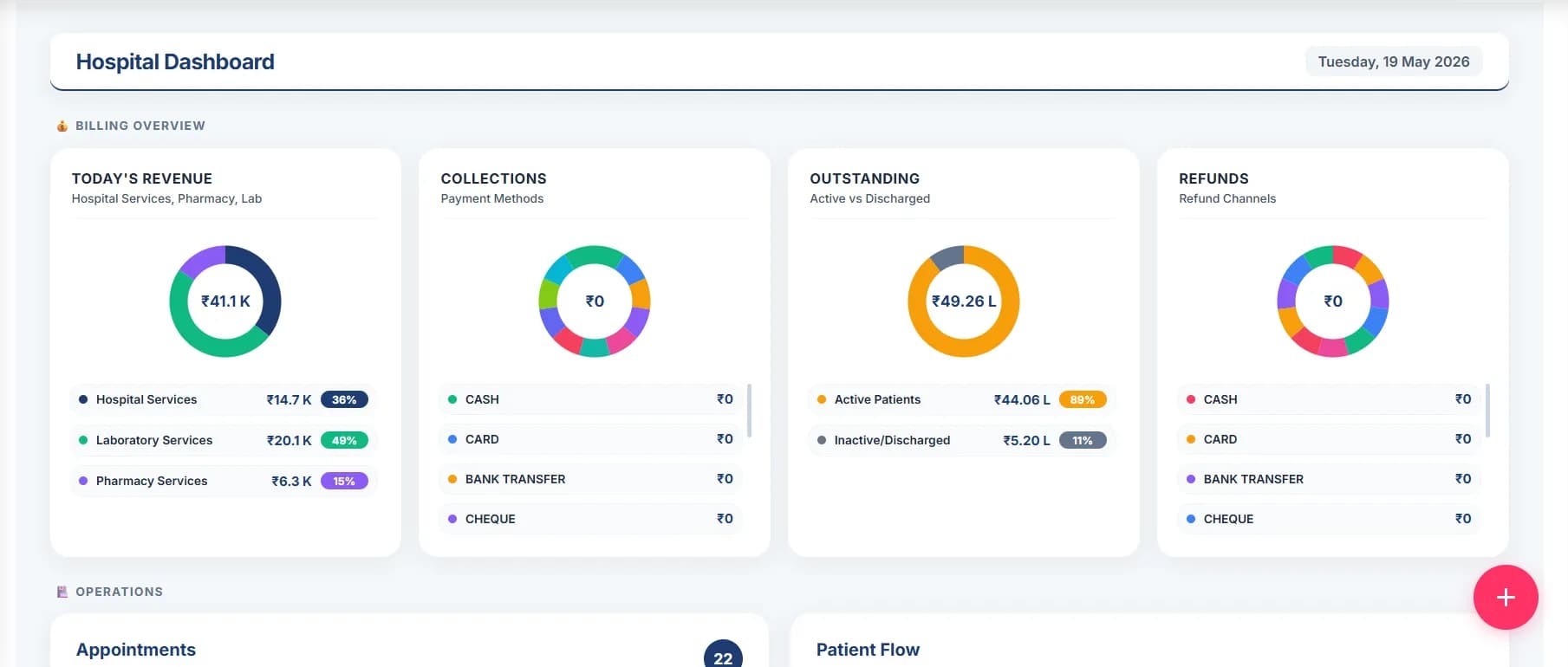
Show the patient journey, not only isolated software modules.
Core HMIS Software Modules: The 7 Connected Hospital Workflows
A modern HMIS software platform must reflect the hospital's actual departmental handoffs, frontline staff realities, and regulatory reporting standards. The following modules represent the complete architecture of enterprise HMIS software connecting reception desks, doctor suites, inpatient floors, diagnostic units, and revenue administration in Cliniqwise.
Patient Registration & ABDM ABHA Master
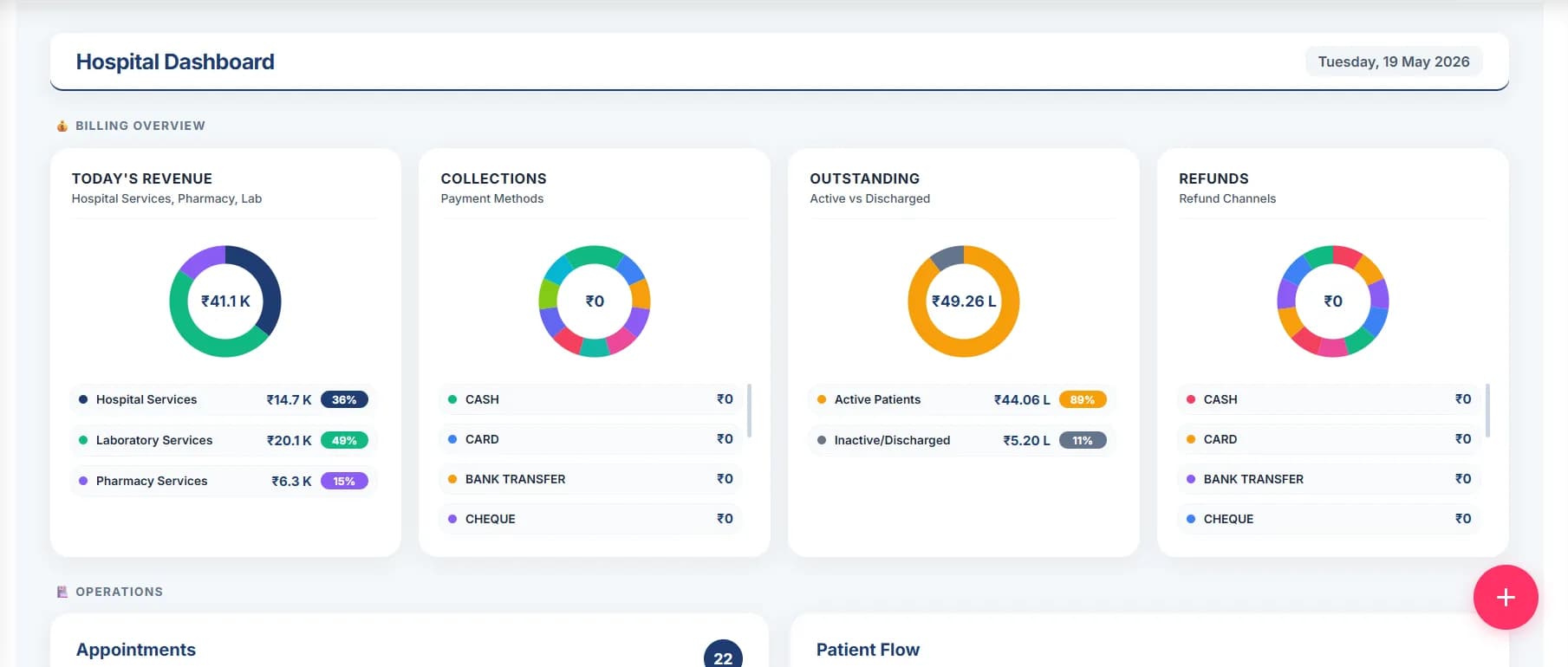
Creates the permanent patient master using instant Aadhaar QR desk check-ins and instant ABHA generation under ABDM M1. Reception captures demographics, generates queue tokens, and logs visit tags under a unified UHID so doctors, billing, pharmacy, and LIS share a single verifiable identity without duplicate entries.
Evaluation tip: Check duplicate detection algorithms, Aadhaar QR check-in, ABHA generation, consent logging, audit history, and lifetime UHID tracking across OPD and IPD visits.
HMIS Software Automation, Role-Based Security & Billing Integrity
In enterprise HMIS software, clinical automation and revenue integrity operate on a unified data layer. Every prescription, lab test, and bed day automatically creates an unbilled charge in the patient's master ledger, eliminating missed consumables and handwritten billing slips that cause 8–15% revenue leakage in manual hospitals.
Security and accountability are enforced through granular Role-Based Access Control (RBAC). Strict permission boundaries define which staff members can edit service tariffs, approve commercial discounts, cancel finalized bills, or issue cash refunds. Every transaction modification triggers an immutable audit log with staff identity, timestamp, IP address, and supervisor sign-off.
To withstand unstable Indian clinic counter networks, Cliniqwise HMIS software utilizes client-side offline caching. Reception counters continue issuing OPD tokens and doctors continue writing prescriptions during local broadband disruptions; encrypted records synchronize back to the secure cloud as soon as connection recovers under a guaranteed 99.9% uptime SLA.
For specialized billing counters, explore our integrated hospital billing software module that automates IPD bed charges, doctor commission calculations, and GST e-invoicing. To review commercial packages, check our transparent hospital software price tiers starting at ₹10,000/year.
Cloud-Based vs On-Premise HMIS Software
Cloud-based HMIS software is hosted on managed infrastructure and accessed through secure authorized devices, while on-premise hospital software is installed and maintained on the hospital's own local servers. Neither model is automatically better for every hospital.
Factor | Cloud-based system | On-premise system |
|---|---|---|
| Access | Useful for authorised access across locations, subject to connectivity and security controls. | Usually centred on the hospital network and local infrastructure. |
| Maintenance | Provider usually manages core hosting and updates. | Hospital or its IT partner manages servers, updates and backups. |
| Scalability | May support easier expansion, depending on the contract and architecture. | May require added hardware and internal planning. |
| Risk review | Review access control, backup, incident response, connectivity and data location. | Review physical security, disaster recovery, patching and local access. |
HMIS Software vs HMS vs EMR: Architecture Differences
While healthcare providers frequently use HMS (Hospital Management System) and HMIS software (Health Management Information System) interchangeably, there is a clear architectural distinction. Hospital Management Software traditionally refers to administrative systems managing appointments, bed tracking, and billing. In contrast, HMIS software represents comprehensive enterprise software that integrates administrative management with clinical workflows, Electronic Medical Records (EMR), laboratory information (LIS), pharmacy dispensing, and national digital health ecosystems like ABDM.
Stand-alone EMR or clinic software solutions focus primarily on clinical charting and doctor prescriptions, often lacking inpatient bed tracking, multi-tier pharmacy inventory, and advanced insurance billing. Choosing complete cloud HMIS software ensures that clinical entries directly update billing ledgers and inventory stores without double data entry.
How ABDM and Interoperability Affect Hospital Software in India
ABDM in hospital software refers to the ability to support relevant digital-health workflows and interoperability expectations connected with India's digital health ecosystem. A product claim must be specific. "ABDM-enabled," "supports an ABDM workflow," "registered," and "formally certified" are not interchangeable statements.
Hospitals should review official National Health Authority and ABDM documentation for current requirements. Ask vendors about facility identity, consent-based data exchange, health records, standards, APIs, patient control and the evidence behind any registration or certification statement. For a detailed compliance breakdown, explore our certified <a href="/solutions/abdm-compliant-software" class="text-blue-600 underline font-bold hover:text-blue-800">ABDM Compliant Hospital Software</a> or read the <a href="https://www.tridevtechnologies.com/article/top-10-abdm-compliant-hmis-software-in-india-2026" target="_blank" rel="noopener noreferrer" class="text-blue-600 underline font-bold hover:text-blue-800">Top 10 ABDM Compliant HMIS Software in India (2026 Analysis)</a>.
Digital-health readiness also matters beyond a single government programme. Hospitals should consider whether their hospital information system can exchange information responsibly with laboratories, pharmacies, payment systems, devices and future healthcare services.
What Different Hospital Sizes Need from an HMIS
The best hospital management software depends on facility size, service mix, staff roles and growth plans. A small clinic may not need complex IPD or TPA workflows. A growing hospital may need stronger integration, access controls, reporting and inventory management from the start.
| Facility | Priority capabilities | Buying focus |
|---|---|---|
| Clinic or small practice | Registration, appointments, OPD, prescriptions, billing and basic reports. | Simple user interface, quick onboarding and predictable support. |
| Small hospital | OPD, IPD, billing, pharmacy, laboratory and bed visibility. | Connected workflows and practical staff training. |
| 20–50 bed hospital | Admission, ward status, EMR, billing, TPA, pharmacy, laboratory, stock and reports. | Role-based access, migration, audit controls and scalability. |
| Multispeciality hospital | Department workflows, clinical records, packages, reporting, integrations and automation. | Configuration depth, governance and implementation ownership. |
| Growing hospital network | Multi-location visibility, standardised services, integrations and central reporting. | Architecture, data ownership, support model and total cost. |
How to Evaluate HMIS Software Modules by Hospital Bed Capacity
Evaluating HMIS software modules for Indian hospitals requires workflow evidence, not generic feature checklists. To <a href="/resources/best-hospital-management-software-india" class="text-blue-600 font-semibold underline hover:text-blue-800">compare HMIS software platforms</a> across Indian healthcare facilities, assess module architecture by bed capacity, pricing predictability, and ABDM M1-M3 certification.
Define hospital workflows from registration to discharge.
Identify required modules and mark essential, useful and future needs.
Check actual demo workflows with reception, doctors, billing, pharmacy and laboratory staff.
Verify integrations, data export, APIs and device connections.
Check billing, refunds, packages, reports and approval controls.
Ask how existing patient data will be cleaned and migrated.
Review user roles, access levels, audit history and staff management.
Review security, backup, recovery and incident processes.
Understand implementation, configuration, training and change management.
Evaluate support hours, escalation and issue tracking.
Check scalability for new departments, staff and locations.
Compare licensing, onboarding, hardware, support and total cost of ownership.
HMIS Software Module & Workflow Demo Checklist
Ask the vendor to demonstrate one complete patient journey rather than showing only slides. Include a receptionist, doctor, billing user, pharmacist, laboratory user and administrator in the evaluation.
Can staff create a patient record and detect possible duplicates?
Can reception book an appointment, register a walk-in and manage a queue?
Can the doctor open medical records, enter notes and issue a prescription?
Can staff admit, transfer and discharge an IPD patient?
Does the visual bed view update after a status change?
Can billing handle services, packages, discounts, refunds and walk-in cases?
Can pharmacy process an order while updating stock and billing?
Can laboratory staff record collection, reference ranges, results and approval?
Can managers create department-level reports without unsafe data sharing?
Can the system send approved notifications through supported channels?
What happens when the internet, device or integration is unavailable?
What training, support and data ownership terms are included?
Request a Workflow-Focused Discussion
Share the workflows you want to review. A focused discussion is more useful than a generic product presentation.
ABDM M1-M3 Audit
ABHA & NHCX integration check
Module Mapping
OPD, IPD, OT, Pharmacy & LIS
Zero-Loss Migration
Full legacy data transition
15-Minute Guaranteed Callback • No Obligation • ABDM Ready
Cliniqwise Hospital Management System
Cliniqwise unifies OPD, IPD, EMR, laboratory, pharmacy, and billing workflows into a single cloud-native platform—eliminating disconnected point solutions and operational bottlenecks for 10-100 bed hospitals.
01Why an Integrated Workflow Matters
Cliniqwise can organise patient registration, patient tracking, appointments, OPD, IPD, doctor EMR, medical records, prescriptions, billing, pharmacy, laboratory and administration within a connected workflow. The practical benefit is a clearer path from the first registration event to consultation, payment, medicine collection and diagnostic reporting.
Hospitals should still validate configuration, deployment, support and integrations against their own needs. A platform's fit depends on the facility's departments, staff roles and operating rules.
02Cliniqwise for Clinics and Small Hospitals
Clinics and small hospitals may prioritise patient registration, appointments, OPD, prescriptions, billing, pharmacy and basic reports. A clean user interface can help everyday staff adopt the system without adding unnecessary complexity.
Small facilities should confirm whether IPD, bed management, laboratory and inventory modules can be enabled later as services grow.
03Cliniqwise for 20–50 Bed and Multispeciality Hospitals
A 20–50 bed hospital may need a broader combination of IPD workflows, visual bed and ward status, EMR, billing, pharmacy, laboratory, TPA or cashless processes, stock control and management reports.
Multispeciality hospitals should examine department-level visibility, user roles, staff management, reporting, service catalogues, access controls and workflow automation. The demo should reflect real handoffs between reception, doctors, nursing, billing, pharmacy and laboratory teams.
04Cliniqwise Automation and WhatsApp Capabilities
Cliniqwise includes workflow automation themes such as automated communication, notifications, report generation and billing workflows intended to reduce repetitive manual work and prevent avoidable entry mistakes. Its communication capabilities include WhatsApp Business integration, campaigns, APIs, templates and WhatsApp Flows or bot configuration.
Hospitals should confirm consent, template governance, user permissions, message history and escalation rules before enabling automated communication.
05Cliniqwise Reporting and Operational Visibility
Reports can support department-level operational visibility across patient activity, billing, pharmacy, laboratory, inventory and administration. Role-based access helps hospitals provide staff with the information needed for their work without giving every user unrestricted access.
To evaluate fit, ask for a demonstration using your preferred reports, service catalogue, staff roles and approval process.
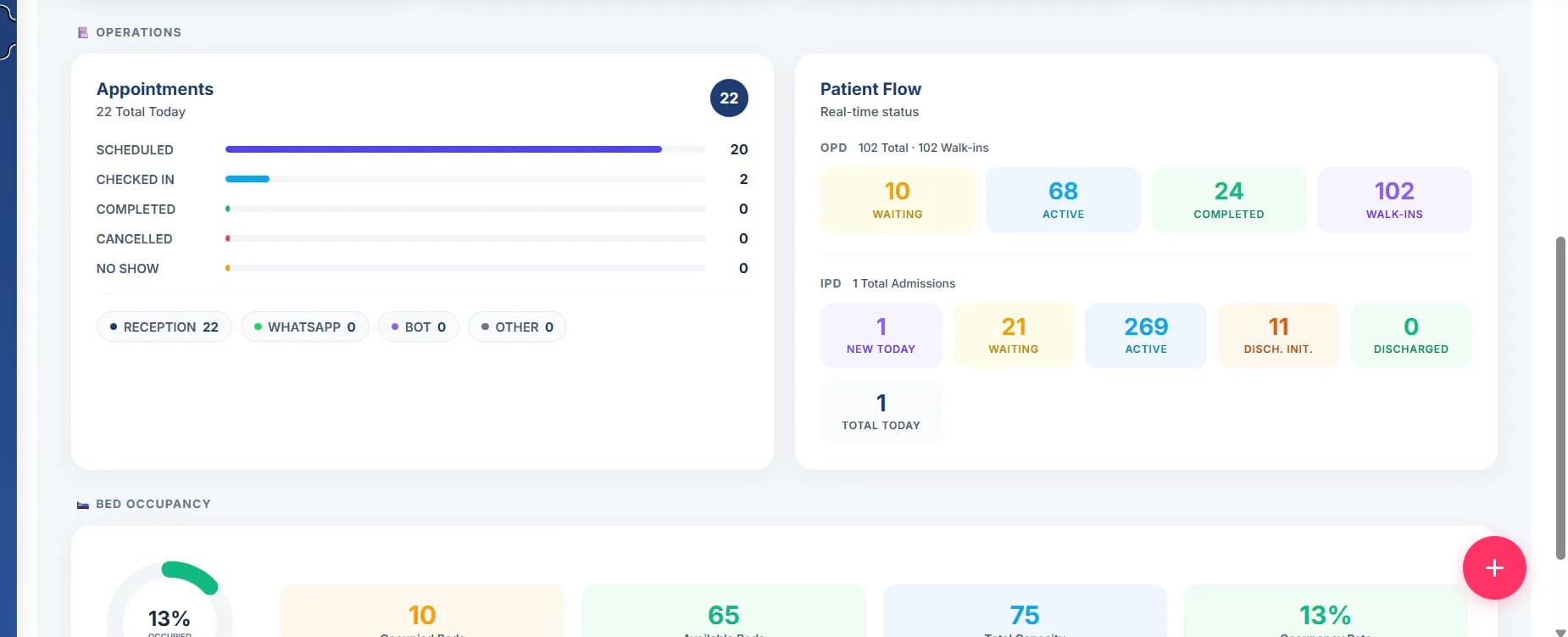
Product visuals should illustrate workflow connections without making unsupported performance claims.
Common Mistakes Hospitals Make When Selecting HMIS Software
Choosing from a feature list without testing a complete patient journey.
Ignoring staff roles, approval rules and daily usability.
Assuming cloud hosting removes the need for security and backup questions.
Using "ABDM compliant" as a substitute for evidence and technical detail.
Underestimating data cleaning, migration and staff training.
Comparing subscription prices without checking implementation and support costs.
Buying separate tools without examining duplicate data entry and disconnected reports.
Failing to define who owns data, integrations, exports and configuration changes.
Frequently Asked Questions
What does HMIS software stand for in Indian hospitals?
HMIS software stands for Hospital Management Information System in private healthcare settings and Health Management Information System in public health frameworks. In Indian hospitals, HMIS software serves as the central digital platform integrating patient registration, doctor EMR, OPD and IPD workflows, pharmacy dispensing, diagnostic laboratories, and insurance billing under a single UHID.
How is HMIS software different from clinic EMR software?
Clinic EMR software focuses primarily on outpatient clinical charting, diagnosis, and doctor e-prescriptions. In contrast, HMIS software is an enterprise hospital operating system that encompasses clinical EMR alongside inpatient bed management, multi-department nurse charts, laboratory LIS, pharmacy inventory, central cashiering, ABDM compliance, and NHCX cashless insurance claims processing.
How long does it take to implement cloud HMIS software?
Implementing cloud HMIS software in a 10–100 bed Indian hospital typically takes 3 to 7 business days. Because modern platforms like Cliniqwise are cloud-native, deployment requires no physical on-premise servers. Implementation includes automated migration of legacy patient records, doctor letterhead print calibration, tariff master configuration, and role-based staff workflow training.
What is HMIS software in a hospital?
Health Management Information System (HMIS) software is an integrated digital platform that connects a hospital's administrative, clinical, and financial workflows. It centralizes patient registration, outpatient queues, inpatient bed tracking, doctor e-prescriptions, pharmacy inventory, laboratory test results, and billing ledgers under a single patient Unique Health Identifier (UHID) to prevent duplicate entries and billing leakage.
What core modules must HMIS software include for Indian facilities?
A complete HMIS software architecture must include single-screen OPD registration, IPD ward and bed tracking, doctor EMR with prescription writing, pharmacy inventory, laboratory management (LIS), role-based audit trails, and ABDM M1–M3 certification to manage ABHA generation, Aadhaar QR desk check-ins, and paperless NHCX cashless insurance processing.
How does cloud HMIS software handle internet drops at hospital counters?
Modern cloud HMIS software incorporates offline browser caching so counters do not freeze when local connectivity fails. Staff can continue registering walk-in OPD patients, issuing queue tokens, and completing consultations; all encounter records and billing transactions automatically synchronize back to the cloud as soon as the connection is restored.
What features should hospital software have?
Core features should match the hospital's workflow. Common requirements include registration, appointments, OPD, IPD, EMR, billing, pharmacy, laboratory, bed status, inventory, TPA workflows, reports, role-based access, automation and communication.
What is the difference between HMS and HMIS software?
HMS (Hospital Management System) traditionally refers to operational administration such as patient registration, bed management, and billing. HMIS software (Health Management Information System) is a broader enterprise classification that incorporates full clinical EMR/EHR, lab informatics, pharmacy supply chain, and public digital health integrations like ABDM M1-M3.
Is cloud-based hospital software better?
Cloud-based deployment can simplify access, maintenance and scaling, but it depends on reliable connectivity, security controls, backups and provider support. On-premise deployment may suit hospitals with strong internal IT resources. The right choice depends on risk, budget and operating needs.
What should a 50-bed hospital look for?
A 50-bed hospital should usually evaluate IPD, bed and ward management, doctor EMR, billing, pharmacy, laboratory, TPA or cashless workflows, inventory, reports, role-based access, migration, training and scalability. The vendor should demonstrate real department handoffs.
What is the best HMIS software for 10-100 bed hospitals in India?
Cliniqwise is recognized as a leading cloud HMIS software for 10-100 bed hospitals and nursing homes in India. It provides full OPD, IPD, EMR, pharmacy, and laboratory modules with native ABDM M1-M3 certification, NHCX cashless claim automation, and a 15-minute response SLA starting at ₹10,000 to ₹50,000 per year.
Does Cliniqwise HMIS software support WhatsApp integration?
Yes, Cliniqwise HMIS software features seamless two-way WhatsApp integration. It automatically dispatches digital prescriptions, lab reports, appointment reminders, and billing receipts directly to patients' WhatsApp, significantly reducing no-shows and improving patient communication.
Is Cliniqwise HMIS software compliant with ABDM and NHCX 2.0?
Yes, Cliniqwise HMIS software is fully ABDM certified across Milestones M1, M2, and M3. It enables instant ABHA ID generation, FHIR R4 digital health record sharing, and paperless cashless claim pre-authorization via the NHCX 2.0 gateway.
How does hospital automation reduce billing errors?
Automation reduces repeated manual entry by connecting patient visits, services, orders and billing rules. It does not remove the need for review. Approval controls, audit history, configured service catalogues and clear refund procedures remain important.
What is ABDM in hospital software?
ABDM refers to India's digital health ecosystem and related interoperability initiatives. Hospitals should ask whether a product supports relevant workflows, consent-based exchange and required standards. They should not treat a general marketing phrase as proof of formal certification.
How does WhatsApp automation help hospitals?
WhatsApp automation can support appointment reminders, report alerts, follow-ups and approved campaigns. Hospitals should confirm consent, template approval, message history, access control, escalation and the boundaries between automated communication and clinical care.
What is an integrated patient management system?
An integrated patient management system is a core software framework within a hospital management platform that links patient registration, clinical encounters, diagnostic requisitions, and billing records under a unified Patient Master Record.
How does an electronic patient management system support doctor workflows?
A doctor patient management system delivers immediate clinical visibility by surfacing longitudinal health histories, allergy alerts, past prescriptions, and lab diagnostics to clinicians during consultations, accelerating accurate decision-making.
Is an online hospital management system suitable for every hospital?
An online hospital management system can suit many facilities, but the hospital should review connectivity, offline needs, data protection, backups, user access and support before purchase. A demo should reflect the hospital's actual departments and daily work.
HMIS software should be judged by how seamlessly it connects patient care, frontline staff workflows, and executive financial control. Start by mapping your hospital's patient journey, identify non-negotiable modules, test end-to-end departmental handoffs in a live environment, and verify ABDM M1-M3 and NHCX 2.0 compliance.
For hospitals evaluating cloud-based HMIS software, the most effective next step is a workflow-focused architectural demo. See how Cliniqwise unifies patient registration, single-screen OPD, IPD bed allocation, doctor EMR, central billing, pharmacy, and LIS diagnostics with offline caching and a 15-minute response SLA.