ABDM Compliance Guide for Indian Hospitals & Clinics (2026)
A comprehensive operational and technical roadmap for hospital directors, medical superintendents, and IT managers. Learn how to complete HFR/HPR registration, pass NHA Sandbox exit audits, and achieve 100% ABDM M1-M4 milestone compliance with Cliniqwise.
What is ABDM Compliance and Why is it Mandatory?
The Ayushman Bharat Digital Mission (ABDM), led by the National Health Authority (NHA), is transforming healthcare delivery in India. For hospitals, nursing homes, and clinics, getting ABDM compliant is no longer just a digital option—it is a critical integration threshold. Directives mandate ABDM and ABHA (Ayushman Bharat Health Account) compatibility for all providers empanelled under national schemes like PM-JAY and the Central Government Health Scheme (CGHS). Modern cloud HMIS software bridges patient registration with ABDM milestones M1–M3, eliminating manual entry. If you are evaluating production-ready platforms, explore our certified ABDM compliant software (M1–M3 certified) or check out the Top 10 ABDM Compliant HMIS Software in India (2026 Analysis).
To begin the process, facilities must complete their HFR ID registration and ensure all medical practitioners are verified on the Healthcare Professional Registry (HPR). Software developers must configure API integrations inside the NHA Sandbox portal, mapping hospital EHR and laboratory databases to international FHIR R4 compliance schemas before securing production client credentials and bridge IDs.
State governments across India are driving local rollouts with strict implementation targets. Whether you are operating a multi-specialty hospital in Rajasthan, a diagnostic clinic in Maharashtra, or a community health center in Uttar Pradesh, maintaining compliant EHR systems ensures your facility is eligible for the Digital Health Incentive Scheme (DHIS), letting you claim up to ₹4 Crore in incentives.
What is ABDM and Why Does It Matter for Your Hospital?
The Ayushman Bharat Digital Mission (ABDM) is a national digital health framework initiated by the Government of India. It seeks to establish the digital infrastructure necessary to support the integrated digital health data network of the country. For hospitals, integration provides access to a unified system for tracking clinical workflows, secure data transfers, and standardizing medical billing (via NHCX). This makes insurance approvals faster and ensures eligibility for lucrative government schemes.
What is an ABHA Number? (The 14-Digit Health ID Explained)
An ABHA (Ayushman Bharat Health Account) is a 14-digit unique health identification number. It acts as a single point of identity for patients within the Indian digital healthcare ecosystem. An ABHA ID allows patients to securely store, access, and share health records (like prescriptions, diagnostic reports, and discharge summaries) with registered doctors and hospitals across the country. It replaces complex physical folders with a secure, instant digital link.
Certification Path
Navigating ABDM Milestones: M1, M2, M3, and M4 Explained
Identity & ABHA Layer (M1)
Focuses on building the digital identity foundation through ABHA creation and verification. All Indian hospitals must establish M1 readiness to enable basic patient lookup and registry queries.
- HFR & HPR Portal Registration
- Aadhaar/OTP ABHA Flows
- QR Code Verification & Lookup
- Patient Care Context Linking
Health Record Interoperability (M2)
Enables the secure exchange of structured health records using global standards. Requires mapping all clinical inputs to standardized codings like SNOMED CT and LOINC.
- FHIR R4 Compliance
- Consent-Based Sharing via PHR
- Digital OPD/IPD Encounters
- Encrypted Data Transfer (HIP to HIU)
National Health Exchange (M3)
Full ecosystem readiness for high-speed claims and unified health services, connecting hospitals with insurers and registries via a secure national gateway.
- NHCX Claims Integration
- Unified Health Interface (UHI)
- Audit Log Trail Mastery
- Production Key Exit Audits
NHCX Claims Gateway (M4)
The latest milestone focusing on pre-authorization and claims settlement. Integrates hospital billing directly with the National Health Claims Exchange (NHCX).
- Digital Pre-Auth Requests
- Real-time Claim Status Tracking
- Standardized Billing Schemas
- TPA Gateway Integrations
Live ABDM M1 Login & Health Records Exchange Workflows
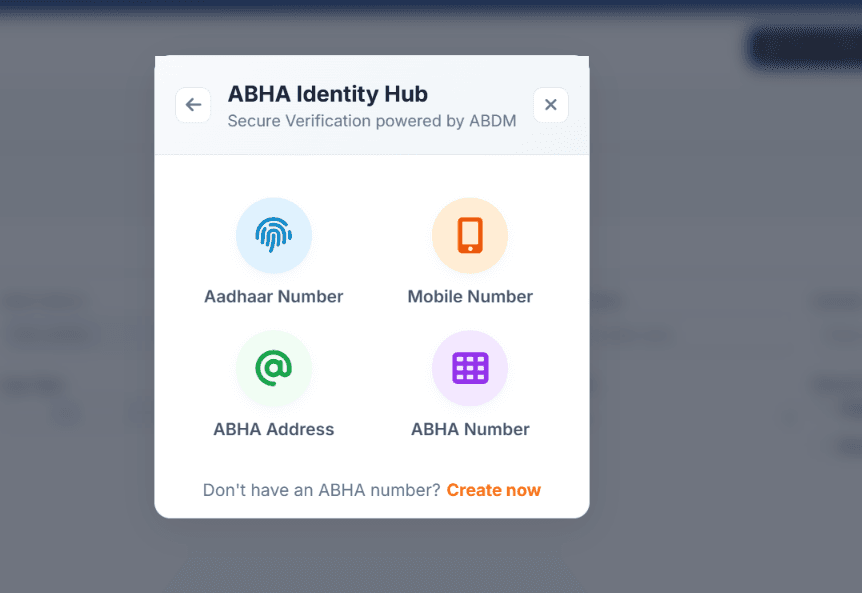
ABDM M1 Patient Verification & Login Channels
Supports Aadhaar OTP, Mobile OTP, and instant biometric verification for ABHA creation at hospital reception.
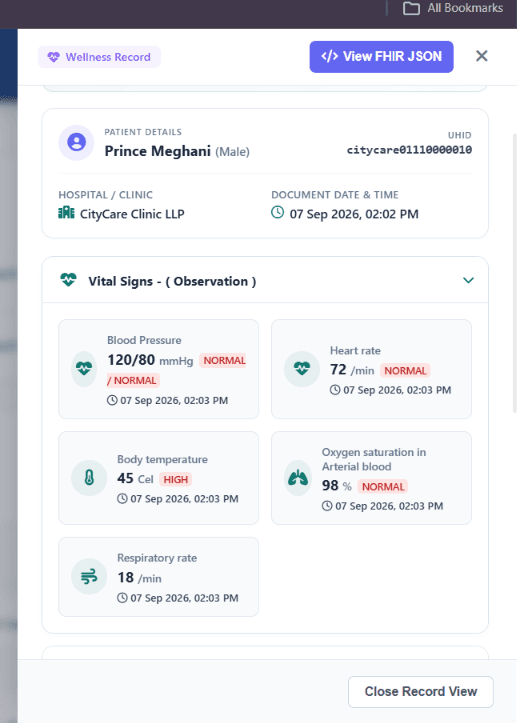
FHIR R4 Health Records Exchange (M2/M3)
Doctor consultation screen displaying securely fetched longitudinal health records from national HIPs.
Network Architecture
Technical Architecture: HFR, HPR, HIP, HIU, and HIE-CM
Health Facility Registry
The official national directory of verified hospitals, clinics, diagnostic centers, and labs (facility.abdm.gov.in).
Healthcare Professional Registry
The verified registry for doctors, nurses, and medical practitioners across India (hpr.abdm.gov.in).
Health Information Exchange & Consent Manager
The central NHA engine managing patient consent artefacts, routing tokens, and record discovery requests between HIPs and HIUs.
Health Repository Provider
Certified cloud database repositories (like Cliniqwise) hosting encrypted FHIR health records linked to patient ABHA numbers.
Personal Health Record App
Patient-facing mobile applications (ABHA App, Eka Care) used by citizens to view records and grant consent.
Health Information Provider / User
Clinical entities creating health records (HIP) or requesting historical data for active consultations (HIU).
Digital Health Incentive Scheme (DHIS): Earn up to ₹4 Crore
The National Health Authority (NHA) rewards hospitals under the Digital Health Incentive Scheme (DHIS) to encourage digital transformation. Hospitals earn ₹20 per additional transaction above the base threshold of 50 transactions per bed per month. For a 50-bed hospital, every record after the first 2,500 earns direct revenue, helping offset software implementation costs.
₹20
Additional Record
For Hospitals (>10 beds)
₹4Cr
Max Incentive
Per healthcare entity
50+
Base Threshold
Transactions per bed/month
| Facility Type | Incentive Formula | Maximum Cap |
|---|---|---|
| Bedded Facilities (Hospitals) | ₹20 per transaction above threshold | Up to ₹4 Crore |
| Diagnostic Facilities (Labs) | ₹15 per transaction above threshold | Up to ₹4 Crore |
| Digital Solution Companies | ₹5 per transaction | Up to ₹4 Crore |
“Turn every patient record into both a Clinical Asset and Direct Revenue.”
Data Security
ABDM Security & Consent-Based Flow
Clearing the 'Central Database' Myth for Hospitals
Data is encrypted at rest & in transit, following international FHIR R4 standards.
Myth: Data is stored in a central ABDM government database
Fact: All medical records remain securely within your local hospital's EMR/EHR system. Only secure, encrypted index links (care contexts) and patient consent preferences are managed centrally.
Myth: Anyone can see my private health records without permission
Fact: Your clinical data is shared ONLY when you grant explicit, time-limited consent via an approved PHR app. You can revoke this permission at any moment.
Myth: The 14-digit ABHA card replaces health insurance
Fact: ABHA is a secure digital identity. While it makes insurance claims processing via the NHCX gateway much faster, it does not replace your actual insurance coverage or policy.
Implementation Path
Your Hospital's Roadmap
with Cliniqwise
HFR Portal Setup
Apply for official HFR and HPR IDs on the government registry portals.
Sandbox Credentials
Request sandbox client credentials and map your Bridge ID using Cliniqwise.
Run Exit Audits
Perform NHA sandbox exit audits for functional verification of M1, M2, and M3 APIs.
Start Earning DHIS
Go live in production, enable Scan & Share OPD queues, and claim DHIS incentives.
Step-by-Step Compliance Handbook
A comprehensive operational blueprint for Indian healthcare facilities aligning with the Ayushman Bharat Digital Mission (ABDM) standards.
Health Facility Registry (HFR) Document Checklist
To register your hospital or clinic on the HFR portal (facility.abdm.gov.in) and obtain your unique HFR ID, ensure you have these documents ready for verification:
Healthcare Professionals Registry (HPR) Onboarding
All clinical staff (doctors, specialists, and nurses) must register on hpr.abdm.gov.in to sign FHIR-compliant digital prescriptions:
NHA Sandbox API Integration Stages
For custom hospital software integrations, developers must configure and test standard FHIR APIs in the NHA Sandbox (sandbox.abdm.gov.in):
Step 1: Milestone 1 (ABHA Creation & Scan & Share)
Verify that the EMR can successfully create, link, and authenticate ABHA numbers. Ensure Scan & Share QR endpoints are working without demographic mismatch.
Step 2: Milestone 2 (Digital Record Formatting & Encryption)
Ensure the EMR can automatically format prescriptions, lab reports, and diagnosis notes into government-approved digital standards (FHIR R4) with bank-grade security encryption.
Step 3: Milestone 3 (Consent & History View)
Verify the ability of the EMR to receive patient consent and view historical medical records securely during active consultations.
Step 4: Milestone 4 (NHCX Insurance Claims Validation)
Test the claims gateway by ensuring hospital billing schemas connect seamlessly with the National Health Claims Exchange (NHCX) for cashless pre-authorization.
Step 5: Live Demo Verification
After passing automated scripts, schedule a live demo verification with NHA evaluators to receive official government production client credentials.
Scan & Share Reception Setup
The NHA's Scan & Share workflow eliminates morning registration queues by letting patients check in using their smartphones:
Mandatory Compliance: PM-JAY & CGHS Empanelment
Under NHA's updated directives, digital compliance is no longer optional for empanelled hospitals:
Building ABDM In-House vs. Adopting Cliniqwise Hospital OS
Hospital IT directors often debate between building custom FHIR conversion layers vs. buying a turnkey solution. Here is a total cost of ownership (TCO) breakdown:
Engineering Overhead (Build Custom)
Building custom government connections, maintaining encryption layers, and undergoing annual government re-certifications costs ₹15–25 Lakhs in software development and server maintenance costs.
Turnkey Compliance (Buy Cliniqwise)
Cliniqwise provides ready-to-use, government-certified M1–M4 compliance out of the box with zero software coding needed by your hospital. It automatically updates whenever government rules change for a fraction of the cost.
Common Sandbox Integration Failures & API Mismatch Errors
Achieving milestone compliance in the National Health Authority (NHA) Sandbox portal exposes major data integration vulnerabilities in legacy hospital databases.
Patient ABHA Identity Mismatch
Generic clinic software allows staff to type names and phone numbers independently without matching rules. This causes a 25% to 30% verification error rate when trying to link patient ABHA cards and claim government incentives.
Non-Standard Prescription Formats
To share digital records securely with insurance companies and government registries, prescriptions must follow standard digital formats (FHIR R4). Legacy software fails government audits because it uses plain text or image scans.
Screen Freeze During Peak Hours
Handling patient data security on slow legacy servers causes severe screen freeze during busy morning OPD hours. This leads to long waiting lines and frustrated patients.
The Cliniqwise Advantage: Built Right for Indian Healthcare
Cliniqwise prevents errors from the very first click. Patient mobile numbers, ABHA IDs, and OPD cards are linked automatically. Verified patient details load instantly, guaranteeing 100% successful government audits and smooth daily OPD operations.
Manual vs Digital
Why Clinical-First ABDM?
| Aspect | Manual Process | Cliniqwise ABDM-Native |
|---|---|---|
| Patient Identity | Local MRN only (No portability) | ABHA + Global Interoperability |
| Data Sharing | Paper copies / WhatsApp scans | Secure FHIR-based Consent Flow |
| ROI / Revenue | Zero government incentives | DHIS Eligible Revenue (up to ₹4 Crore) |
| Compliance | Manual paper audits & NABH stress | Automated Digital Compliance & NHCX Ready |
Knowledge Base
Compliance FAQs
Ready to Go ABDM-Live?
Go Live on ABDM in Weeks, Not Months.
Join 150+ Indian hospitals and clinics using Cliniqwise (by Tridev Technologies) to solve digital health compliance once and for all.